Wing High, Chinese Merchant
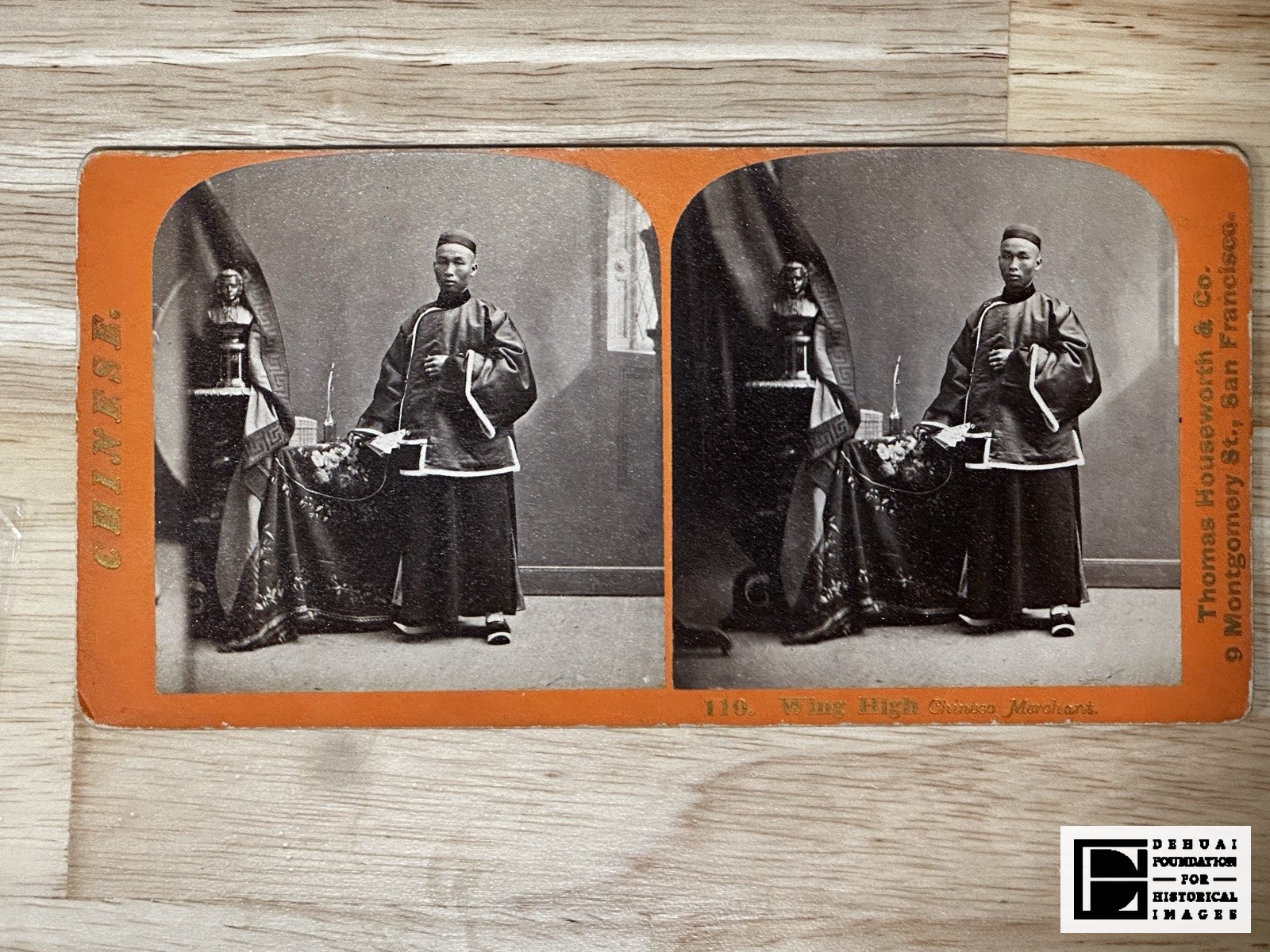
A full-length studio portrait of a man identified on the mount as Wing High, standing beside a cloth-draped table, one hand at his chest and the other holding a folded paper or fan. He…
The objectphotographed as held, uncropped
Catalogue description
A full-length studio portrait of a man identified on the mount as Wing High, standing beside a cloth-draped table, one hand at his chest and the other holding a folded paper or fan. He wears a dark silk over-robe with pale piped edging over a long skirted gown and thick-soled shoes. Behind him a classical bust on a plinth, a patterned drape and a painted backdrop supply the standard furniture of a commercial portrait studio.
The picture is doing two things at once, and they pull against each other. The sitter is named — which is rare, and which makes him a person rather than a type — but the card is filed under the series heading CHINESE, which makes him a specimen. He is posed in exactly the manner a prosperous American merchant would be posed, against exactly the props a prosperous American merchant would be posed against, and then sold as an example of a category.
Portraits like this circulated as parlour entertainment and as evidence in an argument. In the decades when Chinese immigration was being debated in the American press and in Congress, images of Chinese people were reproduced constantly, and the caption did much of the work of telling the viewer what they were seeing.
Transcriptiontext on the object, as printed
CHINESE.
Thomas Houseworth & Co.
9 Montgomery St., San Francisco. [street number reading uncertain]
110. Wing High  Chinese Merchant.
Historical context
Stereographs were among the most widely distributed photographic objects of the nineteenth century, viewed through a hand-held stereoscope in middle-class parlours across the United States. A commercial series titled simply CHINESE indicates that Chinese subjects were a standing category in the publisher’s catalogue.
What is not known
- The street number in the Houseworth imprint is not fully legible in the source photograph; it is transcribed as read and should be re-examined against the object.
- Nothing further about the sitter is established by the object beyond the name printed on the mount. The name as printed may be a transliteration supplied by the studio rather than the name he used.
- Date inferred from imprint and mount style.
TFA-CA-107, “Wing High, Chinese Merchant,” c. 1868-1875. Picturing Chinese America — Tarita Foundation Archive, 2026. Accessed [date].