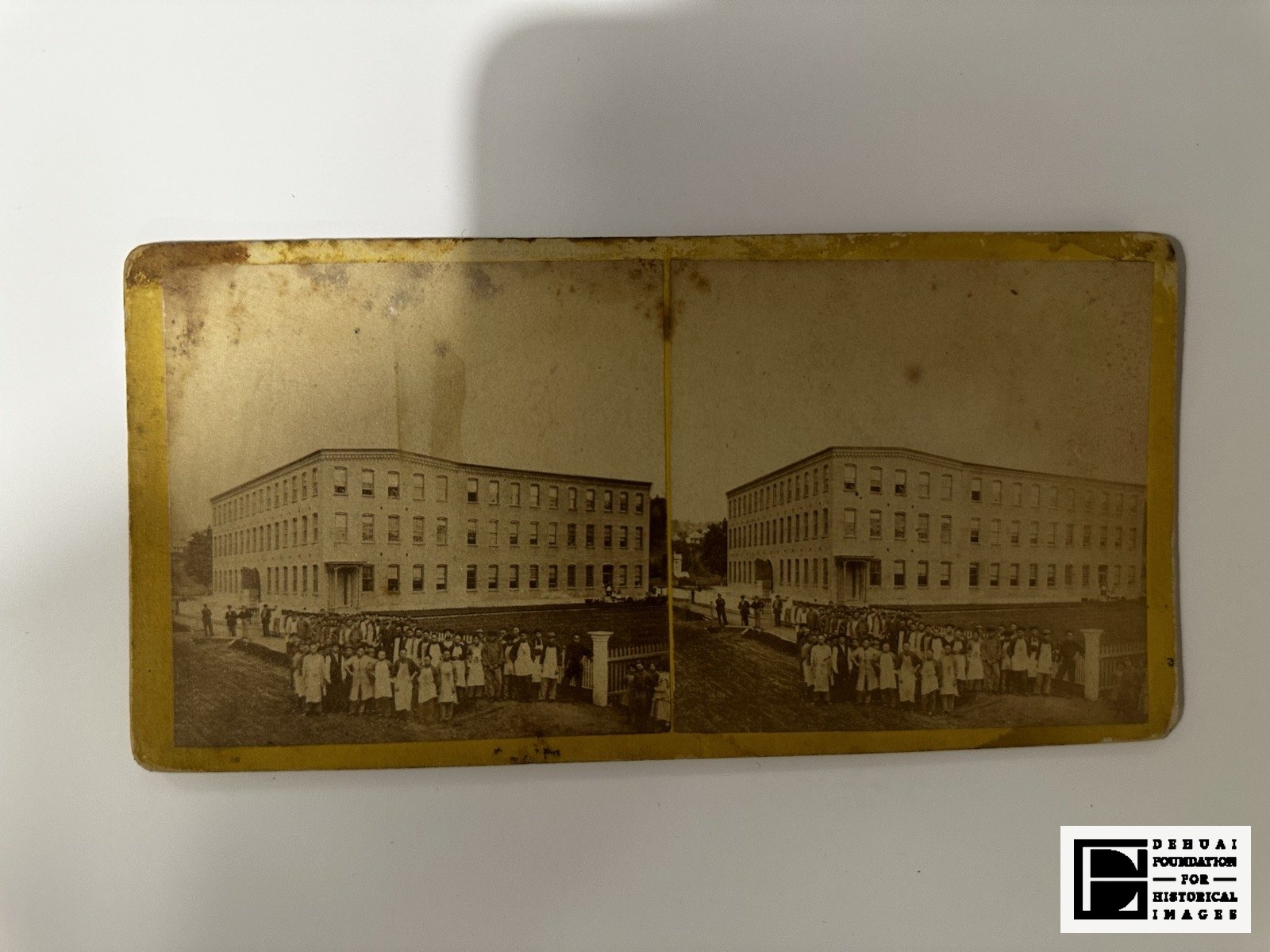
C. T. Sampson’s Shoe Manufactory, with the Chinese Shoemakers in working Costume, North Adams, Massachusetts
A large multi-storey factory building fills the frame, and a long line of workers is drawn up across its whole frontage, facing the camera. The group is arranged for the photograph the way…
The objectphotographed as held, uncropped
Catalogue description
A large multi-storey factory building fills the frame, and a long line of workers is drawn up across its whole frontage, facing the camera. The group is arranged for the photograph the way a company portrait is arranged — assembled outside the building that is the real subject.
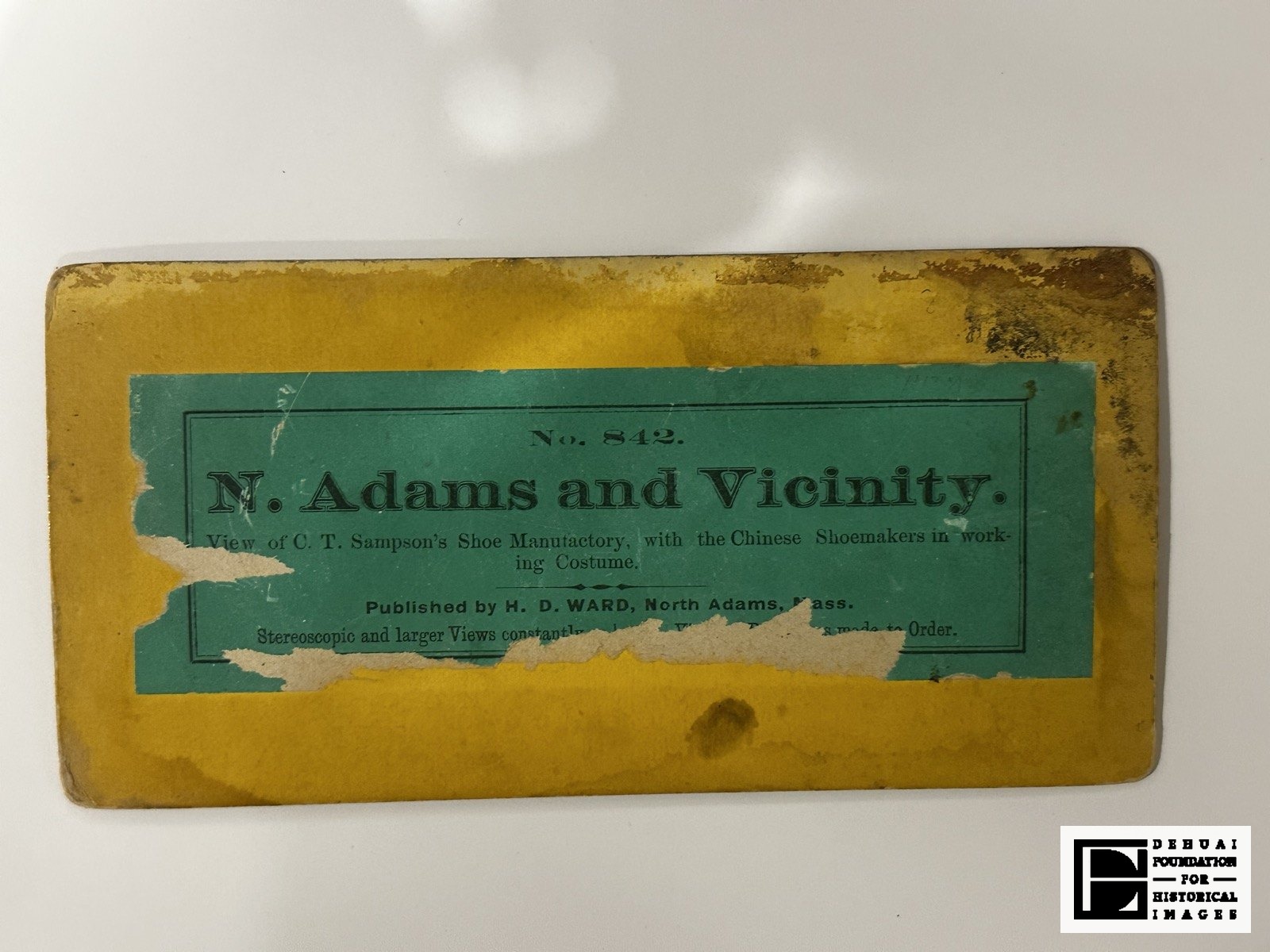
The label states plainly what the view is for: the Chinese shoemakers, in working costume, outside Sampson’s manufactory. It was made to be sold. The presence of these workers in a Berkshire mill town was national news, and a local publisher issued a stereograph of it for people who wanted to see.
This card documents one of the most consequential episodes in nineteenth-century Chinese American history, and it documents it from the position of the town that was selling tickets to it. The men in the line had been recruited in San Francisco and brought three thousand miles east to break a strike; the photograph turns them into the attraction.
Transcriptiontext on the object, as printed
VERSO LABEL:
No. 842.
N. Adams and Vicinity.
View of C. T. Sampson’s Shoe Manufactory, with the Chinese Shoemakers in working Costume.
Published by H. D. WARD, North Adams, Mass.
Stereoscopic and larger Views constantly [torn away] […] made to Order.
Historical context
In 1870 Calvin T. Sampson, a North Adams shoe manufacturer, responded to a strike by the Knights of St. Crispin — then one of the largest labor organizations in the United States — by contracting for seventy-five Chinese laborers from San Francisco. They arrived under police escort on 13 June 1870, most of them between roughly sixteen and twenty-two years old, working eleven-hour days for wages far below those the strikers had demanded. The strike was broken. The episode provoked protest meetings across the country, fed congressional debate over contract and foreign labor, and helped make Chinese immigration a sustained national political question in the years leading to the Chinese Exclusion Act of 1882. Some of the men remained in the Berkshires; graves of two of them have since been identified in a North Adams cemetery.
What is not known
- The mount face and the labelled verso are treated as one object on the basis of matching yellow stock and sequential photography.
- The date is inferred from the 1870 arrival of the Chinese workers and the mount style; no date is printed.
- Text at the right edge of the label is lost to a tear and cannot be recovered from this copy.
- No individual in the line is identified.
TFA-CA-106, “C. T. Sampson’s Shoe Manufactory, with the Chinese Shoemakers in working Costume, North Adams, Massachusetts,” c. 1870-1875. Picturing Chinese America — Tarita Foundation Archive, 2026. Accessed [date].