"CHINESE FRIENDS": bilingual appeal for a shot-down American flyer, tied by a US Navy ship's datestamp, 1945
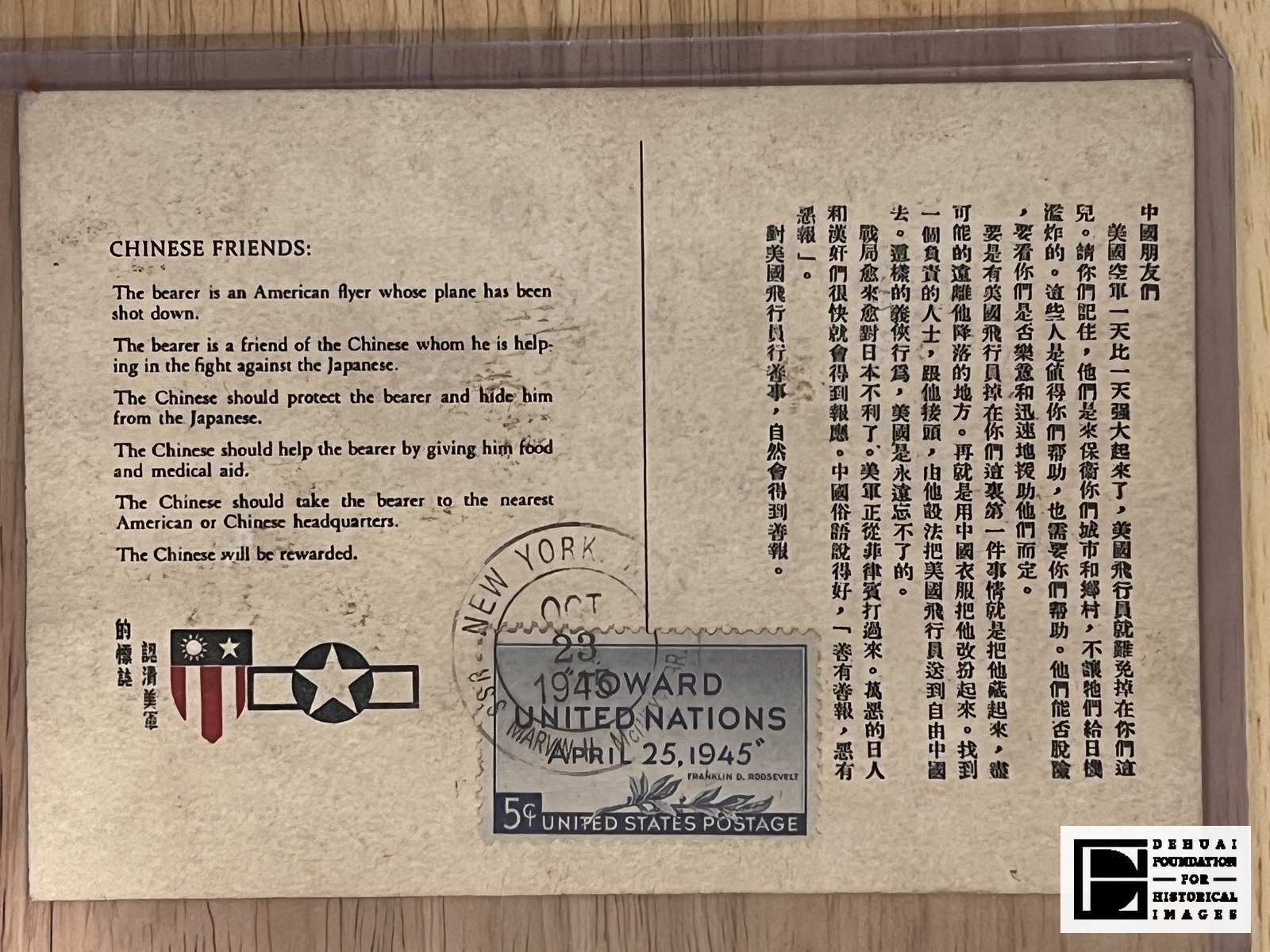
A single printed leaf divided down the middle by one vertical rule. At the left, a bold roman heading and six short English sentences in a lighter serif: "CHINESE FRIENDS:", then the bearer…
The objectphotographed as held, uncropped
Catalogue description
A single printed leaf divided down the middle by one vertical rule. At the left, a bold roman heading and six short English sentences in a lighter serif: "CHINESE FRIENDS:", then the bearer is an American flyer whose plane has been shot down, he is a friend of the Chinese, the Chinese should protect him and hide him from the Japanese, should feed him and give him medical aid, should take him to the nearest American or Chinese headquarters. The last line is the transaction: "The Chinese will be rewarded." Below the text sit two devices printed side by side. The first is a shield whose chief carries the white sun of the Republic of China at the left and a single white star at the right on a dark field, over three red stripes hanging as separate bands. The second is the United States star-and-bar aircraft insignia — a white star in a circle flanked by rectangular bars. To their left, in two short vertical columns, 認清美軍的標誌 [Recognise the insignia of the American forces].
The right-hand side of the sheet carries a much longer Chinese text, twelve vertical columns of Chinese under a heading that stands alone in the rightmost column, 中國朋友們 [Chinese friends], set as four paragraphs. It is not a translation of the English. It is a separate address to the finder, and it argues rather than instructs: the American air force is growing stronger by the day, so airmen will come down among you; remember that they are here to keep Japanese aircraft from bombing your cities and villages; hide the man as far as possible from where he landed, dress him in Chinese clothes, find a responsible person to pass him on to Free China. It then reports on the war — American forces are fighting their way over from the Philippines, and the Japanese and the 漢奸 [Chinese traitors] will get their retribution — quotes the proverb 善有善報,惡有惡報 [Good is repaid with good, evil is repaid with evil], and closes by turning the proverb into an offer: 對美國飛行員行善事,自然會得到善報 [Do a good deed for an American airman and you will naturally receive a good reward].
The two halves perform two different framings of the same encounter. The English is written to be held out by the airman and read over his shoulder by his own side: it calls him "the bearer," states his claim on the person in front of him, and files that person under the single collective word Chinese, in the third person — "The Chinese should," three times, and then "The Chinese will be rewarded." The Chinese text addresses the same finder directly, in the second person, credits him with a decision to make, and attaches to it a reward, a threat to collaborators and a promise of remembrance. The sheet carries both an instruction and an argument, and the price is named on both sides of the rule.
A United States adhesive has been affixed to the printed sheet itself and cancelled. The 5c stamp inscribed "TOWARD UNITED NATIONS / APRIL 25, 1945", with FRANKLIN D. ROOSEVELT beneath, is stuck to the printed sheet at lower centre, straddling the dividing rule but covering no printed text, and is tied by a circular datestamp reading NEW YORK across the top arc, U.S.S. MARVIN H. McINTYRE around the bottom arc, and OCT / 23 / 1945 in the centre. The dial falls mainly on the English half, in the blank paper below the last English line. No addressee, return address, censor mark or transit marking appears on this face. The archive catalogues the sheet as a postal cover to describe its surviving physical state — a stamp affixed and cancelled — not to assert that it travelled as mail. What can be said is that a sheet whose printed text addresses a Chinese finder on behalf of an airman carrying it ended up carrying a United States stamp cancelled by a warship's own datestamp; what happened between those two facts the object does not record.
Transcriptiontext on the object, as printed
LEFT-HAND COLUMN (English), one line per printed line:
CHINESE FRIENDS:
The bearer is an American flyer whose plane has been
shot down.
The bearer is a friend of the Chinese whom he is help-
ing in the fight against the Japanese.
The Chinese should protect the bearer and hide him
from the Japanese.
The Chinese should help the bearer by giving him food
and medical aid.
The Chinese should take the bearer to the nearest
American or Chinese headquarters.
The Chinese will be rewarded.

CAPTION AT THE DEVICES, set as two short vertical columns to the left of the shield, read right column first:
認清美軍 / 的標誌 = 認清美軍的標誌 [Recognise the insignia of the American forces]

RIGHT-HAND SIDE (Chinese, vertical columns read right to left). [Editorial note: the Chinese occupies thirteen vertical columns read right to left. The heading stands alone in the rightmost column; the body runs across the remaining twelve columns and is set as four paragraphs, each beginning at the head of a column, the preceding column ending short at 而定。, at 忘不了的。 and at 惡報」。. Within a paragraph the sentence breaks do not coincide with the column breaks; the division into lines below is editorial, made to carry a bracketed translation after each passage, and is not the printed layout.]

中國朋友們 [Chinese friends] — heading, standing alone in the rightmost column
美國空軍一天比一天強大起來了,美國飛行員就難免掉在你們這兒。 [The American air force grows stronger day by day, and so it cannot be avoided that American airmen will come down among you.]
請你們記住,他們是來保衛你們城市和鄉村,不讓牠們給日機濫炸的。 [Please remember that they have come to defend your cities and villages, to keep them from being bombed indiscriminately by Japanese aircraft.]
這些人是值得你們幫助,也需要你們幫助。 [These men deserve your help, and they need your help.]
他們能否脫險,要看你們是否樂意和迅速地援助他們而定。 [Whether they escape danger depends on whether you are willing to help them, and quickly.]
要是有美國飛行員掉在你們這裏第一件事情就是把他藏起來,盡[?]可能的遠離他降落的地方。 [If an American airman comes down where you are, the first thing is to hide him, as far as possible from the place where he landed.]
再就是用中國衣服把他改扮起來。找到一個負責的人士,跟他接頭,由他設法把美國飛行員送到自由中國去。 [Then disguise him in Chinese clothes. Find a responsible person, make contact with him, and let him arrange to send the American airman to Free China.]
這樣的義俠行為,美國是永遠忘不了的。 [Such an act of chivalrous righteousness America will never forget.]
戰局愈來愈對日本不利了。美軍正從菲律賓打過來。萬惡的日人和漢奸們很快就會得到報應。中國俗諺說得好,「善有善報,惡有惡報」。 [The war turns more and more against Japan. American forces are fighting their way over from the Philippines. The utterly evil Japanese and the Chinese traitors will soon get their retribution. The Chinese proverb puts it well: "Good is repaid with good, evil is repaid with evil."]
對美國飛行員行善事,自然會得到善報。 [Do a good deed for an American airman and you will naturally receive a good reward.]

ADHESIVE STAMP (lower centre, affixed across the printed rule):
["]TOWARD
UNITED NATIONS
APRIL 25, 1945"
FRANKLIN D. ROOSEVELT
5¢  UNITED STATES POSTAGE

CIRCULAR DOUBLE-RING DATESTAMP tying the stamp (one strike, struck across both stamp and sheet):
outer ring, top arc:     NEW YORK[.] [any following state abbreviation is not legible]
outer ring, bottom arc:  U.S.S. MARVIN H. McINTYRE
centre:                  OCT
                         23
                         1945

No other printed, typed, stamped or handwritten text is present on this face: no imprint line, no leaflet or series number, no addressee, no return address, no censor or transit marking and no pencil annotation. All four edges were examined at full resolution.
Historical context
Leaflets addressed to Chinese civilians about shot-down American airmen were produced for the China theatre by the United States Office of War Information, which issued them in a numbered CA series. Among the leaflets described in that series are CA-114, which shows a farmer bringing an American pilot into his hut over the line that Americans will never forget the people who helped them and which reproduces a "blood chit" bearing an American flag in full colour, and CA-132, a "pointie-talkie" card of the kind made for a finder who might be illiterate, showing American and Chinese airmen displaying their blood chits. The psywarrior page uses the term blood chit for a notice carried by an airman identifying the bearer as an American and asking that he be helped; that is the form the English half of this sheet takes. The archive has matched this sheet to no leaflet in that series: the page relied on for the CA numbering is a hobbyist site, and it does not describe any leaflet headed CHINESE FRIENDS with this text. USS Marvin H. McIntyre (APA-129), whose name appears in the datestamp, was a Haskell-class attack transport commissioned on 28 November 1944. She entered Manila Bay on 14 June 1945 carrying Army Air Corps personnel, was at Guam on 21 August 1945, reported at Nagasaki on 30 October 1945 for "Magic Carpet" repatriation duty and reached Seattle on 21 November 1945. Where she lay on 23 October 1945, the date in the dial, is not recorded in that account.
What is not known
- No issuing agency, printer, leaflet number, series number or date appears anywhere on the photographed face, and the archive has matched this design to no catalogued leaflet or blood chit. The Office of War Information's production of leaflets of this class for China is established for its numbered CA series generally, not for this sheet.
- Only one face has been photographed. Whether the reverse is blank, carries printing, or carries an address, a sender's name or further markings is unknown.
- The character transcribed 盡[?] in 盡[?]可能的遠離他降落的地方 is heavily over-inked and was examined at full resolution by the editor. 儘 is the alternate orthography for the same word and cannot be excluded at this resolution. A reading of 越 was proposed during drafting and is rejected here: 越可能的遠離 is not idiomatic, and the sense required — as far as possible — is that of 盡/儘.
- The character read as 牠 in 不讓牠們給日機濫炸的 is read as printed; the reading is probable rather than certain at this resolution, and no source has been consulted on the period use of that character.
- The outer ring of the datestamp is only partly legible. NEW YORK is clear across the top arc and U.S.S. MARVIN H. McINTYRE around the bottom arc of the same single strike; whether a state abbreviation follows NEW YORK could not be read. The archive has not established why a ship whose recorded movements in 1945 were in the Pacific carried a New York fleet post office dial, and offers no explanation for it.
- Where the ship lay on 23 October 1945 is not established. The service history consulted places her at Guam on 21 August and at Nagasaki on 30 October; the intervening position is an interpolation the archive does not make.
- Whether this item ever travelled as mail is not established. There is no addressee, return address, censor mark, transit marking or arrival marking on this face; a stamp tied by a ship's own datestamp with no address is equally consistent with a cancellation applied on board as a favour.
- Whether the sheet was ever distributed in China, was carried by an airman, or was obtained as unissued stock is not established by the object. Nothing connects this copy to any particular airman, unit or rescue, and the person who affixed the stamp is not identified.
- The star-and-bar device is printed in black only, so the archive can say nothing about which variant of the United States national aircraft insignia is reproduced, and attaches no pattern year to it.
- The 5c adhesive is identified here only by the wording printed on it. No catalogue number, issue date or place of issue is asserted; the archive did not fetch a philatelic authority within its research budget.
- The sheet has not been measured; no dimensions or proportions are recorded.
- No source carrying the claim was successfully fetched for the ground organisation of airman rescue in China (the Air Ground Aid Service and its associations), so that material has been left out of historical_context rather than rest on search summaries.
- The date of this printing is not established. The 23 October 1945 datestamp gives only a date by which this sheet existed; nothing on the sheet dates the printing, and whether this is an early or a late impression of the design cannot be determined from the photographed face.
- date_sort 1944 rests on the editor's dating of the Philippines campaign named in the printed text; no source for that campaign's dates was fetched.
TFA-CA-136, “"CHINESE FRIENDS": bilingual appeal for a shot-down American flyer, tied by a US Navy ship's datestamp, 1945,” Printed text undated; the printed Chinese reports American forces fighting their way over from the Philippines, so the text was composed while that campaign was under way. The sheet carries a 5c United States adhesive tied by a ship datestamp reading OCT 23 1945.. Picturing Chinese America — Tarita Foundation Archive, 2026. Accessed [date].