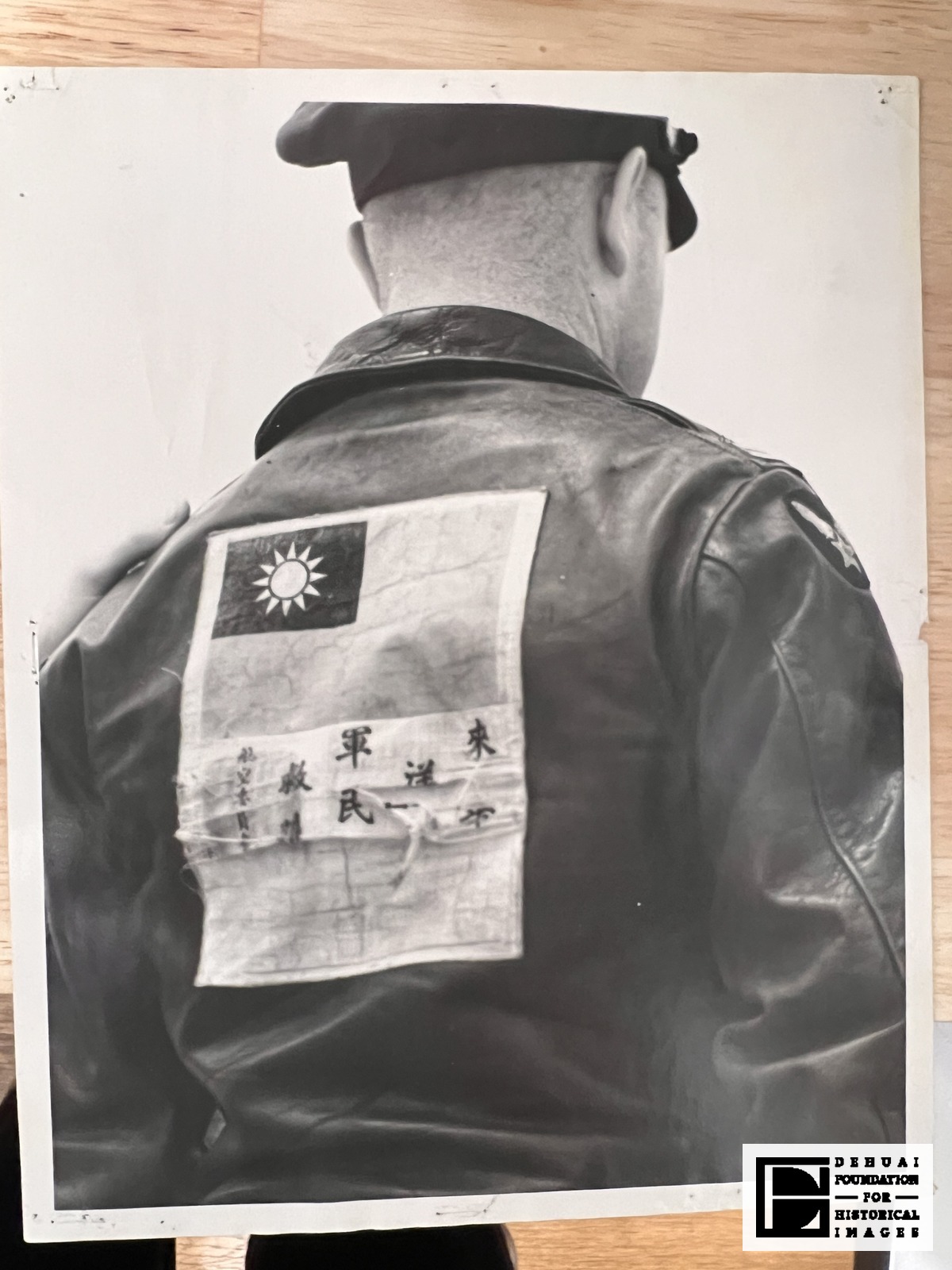
Man photographed from behind, a Chinese blood chit sewn to the back of his leather jacket
A man photographed from behind, filling most of the frame. He is cut by the picture edge below the waist, at the left, and at the right below the shoulder; at shoulder height there is white…
The objectphotographed as held, uncropped
Catalogue description
A man photographed from behind, filling most of the frame. He is cut by the picture edge below the waist, at the left, and at the right below the shoulder; at shoulder height there is white between his right shoulder and the picture edge. The crown of his cap is complete, with an unbroken white field above it; where the top of the printed image lies cannot be told, the photograph's background there being blank white. A shaved neck, one ear, and a leather jacket creased hard across the shoulders and rucked at the sleeves. His face is not shown and nothing on the print names him. Sewn to the back panel of the jacket, square to the camera, is a rectangle of pale cloth with its edges stitched down and its lower half pulled into a diagonal fold. A dark patch bearing a pale star-like device sits on the sleeve at frame right, seen so obliquely that no lettering can be made out.
The cloth is a blood chit. It carries the flag of the Republic of China at the upper left — dark canton, white twelve-pointed sun — and below it characters in a brushed calligraphic style in four right-to-left columns, an arrangement consistent with the standard twelve-character layout. The fold leaves 來 [come], 洋 [of the ocean; here, foreign], 軍 [soldiers], 民 [civilians], 救 [rescue] and a single 一 [one] stroke legible, together with a half-character below 來 [come] that is consistent with 華 [China], which is the standard chit formula: a foreigner has come to China to help in the war, and soldiers and civilians, one and all, should rescue and protect him. A short line of much smaller characters runs down the left edge of the panel, illegible here, and a faint mottled block of tone lies across the lower half of the field; what that tone is cannot be determined from this print. The literature on surviving chits describes the red chop of the Chinese Nationalist government's Commission for Aeronautical Affairs as centred, or close to centred, on the white field among the characters, and records serial numbers on chits of that pattern. This is a black-and-white photograph, and neither the chop nor a number can be read on it.
The caption on this object is sewn to the wearer's back, and it is written in Chinese for Chinese readers. It supplies no name, rank, unit or nationality; it supplies a category — 洋人 [a Westerner], one who has come to help — and addresses a demand to whoever finds him. The demand runs one way: it asks Chinese soldiers and civilians to rescue and protect the wearer, and says nothing of what rescuing him might cost them. The picture shows the panel square to the camera and his face not at all.
Nothing else on this copy carries information. There is no caption slug, agency stamp, credit line or pencil note anywhere on the face, and the reverse was not photographed, so any caption, date or agency mark it may bear is unrecorded. Whether the sheet is a wartime print or a later copy print cannot be told from the face alone.
Transcriptiontext on the object, as printed
RECTO: the only text on the object is on the cloth panel sewn to the back of the jacket.

The panel carries a Republic of China flag at the upper left — dark canton bearing a white twelve-pointed sun around a ringed disc, plain field to the right and below. No text in or beside the flag.

Below the flag, characters in a brushed calligraphic style run in vertical columns read right to left; four column positions are visible, and the arrangement is consistent with the standard layout of four columns of three, though no column shows all three characters in the photograph. The cloth is folded across the middle of the inscription and the drape of the jacket throws the surface out of plane, so part of the text is hidden and the surviving characters do not sit on a regular grid in the photograph. Single characters are glossed in brackets at first mention. What is legible, by position on the cloth:

Column 1 (rightmost): 來 [come] / 華[?] [China] / [hidden by the fold]. The second character is cut across by the fold; a horizontal bar with a hooked end and a descending vertical survive, consistent with 華 [China] and equally with 助 [help].
Column 2: [hidden by the fold] / 洋 [of the ocean; here, foreign] / [hidden]
Column 3: 軍 [soldiers] / 民 [civilians] / [hidden]
Column 4: [hidden by the fold] / 救 [rescue] / [illegible — a smear of two or three dark vertical strokes with no recoverable structure]

One further character is legible but cannot be placed with confidence: a single heavy horizontal stroke, 一 [one], which photographs to the right of 民 [civilians] and about one character-pitch higher than a flat grid would put it. The fold tucks the cloth away between the columns; the formula places 一 [one] at the foot of column 3.

The legible characters and the four-column arrangement are those of the standard wartime chit text 「來華助戰洋人 軍民一體救護」 [This foreigner has come to China to help in the war effort; soldiers and civilians, one and all, should rescue and protect him]. The published English renderings differ in their ending: warbirdforum gives "should rescue, protect, and provide him medical care", 救護 [rescue and protect; also to render aid] carrying the sense of rendering aid as well as of protection, and 洋人 [a Westerner] is period usage for a Westerner rather than for a foreigner generally. The break between the two six-character clauses is editorial; no punctuation is written on the cloth.

At the left edge of the panel, a short vertical line of much smaller characters: [illegible]. Four to six marks can be made out in the photograph, the lowest heavier than the rest, but the number cannot be fixed.

Across the lower half of the panel, faint ghosted rectangles and lines: [illegible].

No other text. No caption, stamp, credit line or annotation appears on the print, and the verso was not photographed.
Historical context
Rescue patches for foreign aircrew flying for China date from 1937, when Claire Chennault became an adviser to China's air force; warbirdforum's survey of surviving examples records chits issued to the 14th Volunteer Squadron, the American Volunteer Group, the China Air Task Force and the Fourteenth Air Force across the 1930s and 1940s. Chits of the American Volunteer Group pattern carry the red chop of the Nationalist government's Commission for Aeronautical Affairs, described in that survey as centred or near-centred on the white field among the characters, together with a serial number; a collector's account quoted there — Richard Peacher's — records that Chennault held back the first two hundred chits, including no. 0001, which went on his own jacket. When the United States entered the war in December 1941, American flight-crew survival kits included chits printed in fifty languages carrying an American flag and promising a reward for a pilot's safe return; American crews also had chits sewn to the backs of their flight jackets, some units putting them on flight suits instead. The flag on a man's back was a political object as well as a rescue device, and the demand it printed had a price on the other side of it. Air & Space Forces Magazine records that some China-Burma-India crews had trouble with the flags sewn to their jacket backs: a few who came down in Chinese Communist-held territory had difficulty explaining their allegiance to the Nationalists while wearing the Nationalist flag, and Chennault and others had their flags sewn into the lining instead. For Chinese civilians the exposure was of another order. After the Doolittle Raid of April 1942, Japanese forces mounted the Zhejiang-Jiangxi campaign in search of the American airmen who had come down in China, burning towns and villages suspected of harbouring them and executing civilians. Chinese official records count at least 66,526 civilians killed, wounded or missing in Zhejiang province in 1942; Chennault and the missionary Vincent D. Smith each reported a figure of 250,000 Chinese deaths from Japanese reprisals during that campaign.
What is not known
- The man is not identified, and neither is his nationality or service. Nothing on the print gives a name, rank, unit or country, no name tape or maker's label is visible, and the chit itself says 洋人 [a Westerner], not an American. The archive does not assign him to the American Volunteer Group, the China Air Task Force or the Fourteenth Air Force.
- The patch on his right sleeve is seen edge-on and resolves only as a pale star-like device on a dark field; it carries no legible lettering and is not identified.
- The jacket is a dark leather flying-type garment; no pattern designation (A-2 or other) is established from the image.
- The date is inferred from the chit's flag and text, not stated. Nothing on the recto is dated. The chit's own issuing line and government chop are not legible here, so this chit cannot be assigned to the 1941 Commission for Aeronautical Affairs pattern and the date cannot be narrowed below c. 1937–1945.
- Whether this sheet is a wartime print or a later copy print is not established, and the photographic process is not determined from a snapshot of the print. The sheet was not measured.
- Only the recto was photographed. Any caption slug, agency stamp, date or annotation on the reverse is unrecorded.
- The fold across the cloth hides five of the twelve characters. The full string 來華助戰洋人 軍民一體救護 [This foreigner has come to China to help in the war effort; soldiers and civilians, one and all, should rescue and protect him] given in the transcription is a reconstruction from the standard formula; only 來 [come], 洋 [foreign], 軍 [soldiers], 民 [civilians], 一 [one] and 救 [rescue] are securely read on this object.
- The second character of column 1 is read 華[?] [China]. Only a horizontal bar with a hooked end and a descending vertical survive above the fold; the reading rests on the character pitch and on the formula, and 助 [help] is an equally possible reading of those strokes.
- The third character of column 4, where 護 [protect] would fall, is an unstructured smear at full resolution and is recorded as [illegible]; the draft's reading 護[?] over-stated what is visible.
- The 一 [one] stroke photographs to the right of 民 [civilians] and one character-pitch high, inside the horizontal range of column 2. Its assignment to the foot of column 3 is a reconstruction from the formula; column positions cannot be read off the draped cloth with confidence, and no column shows all three of its characters in the photograph.
- The short line of much smaller characters at the left edge of the panel is illegible and its character count cannot be fixed; the issuing line, if that is what it is, and this chit's serial number are not established.
- The faint mottled block of tone across the lower panel is not identified. Calling it the Commission's chop would be an inference; the chop is described in the literature as sitting centred among the characters, not below them.
- Whether the chit is silk or cotton cannot be determined from the image.
- The photographer, the place, the date and the occasion of the photograph are unknown, as is whether it was made for a news agency, for a service unit or privately. The place recorded in geo is the country the chit names, not a located place of photography.
- The marks in the print's margins are not identified; whether they are adhesive residue, scuffing or surface dirt cannot be told from the photograph, and nothing on the object records how they got there.
- Whether the characters on the cloth are printed or written by hand cannot be determined from this photograph.
TFA-CA-119, “Man photographed from behind, a Chinese blood chit sewn to the back of his leather jacket,” Photograph c. 1937–1945 (inferred from the Republic of China flag and the twelve-character rescue text on the chit); this printing undated. Picturing Chinese America — Tarita Foundation Archive, 2026. Accessed [date].